
Author: gautampk
Issue 9
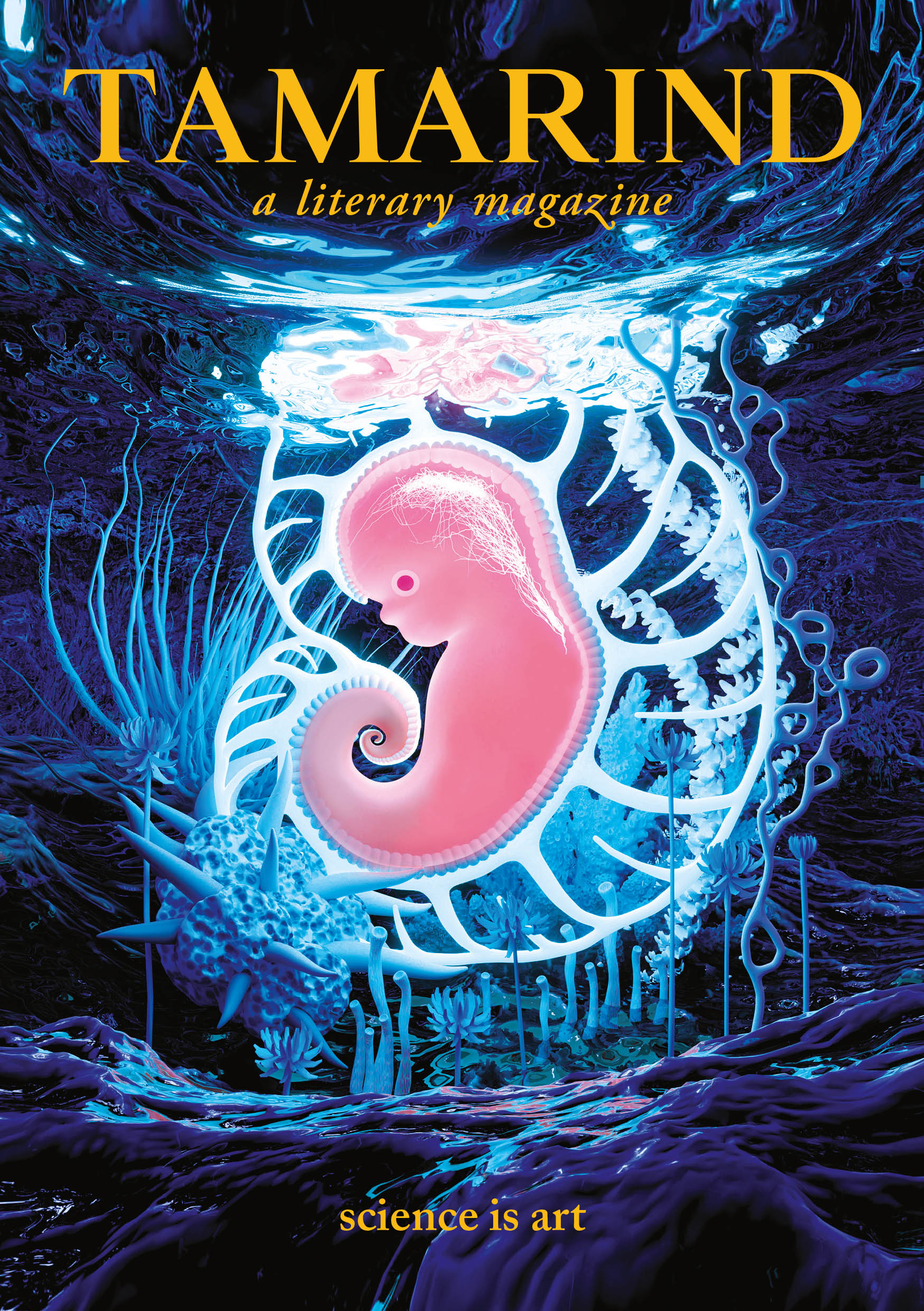
Issue 9 of TAMARIND is now available for purchase in digital and in print. Back issues are also available to buy, while stocks last.
You can read and download current and past issues of the magazine online at read.tamarindlit.co.uk. Just enter your order number, issue number, and email address.


EDITORIAL
Many areas of our lives are mysterious: the areas of the past unlit by history, the knowledge beyond the bounds of our science, and the ambiguities of human language. The boundaries between disciplines, like the fine line between science and art, are an opportunity to probe those things that are beyond our reach.
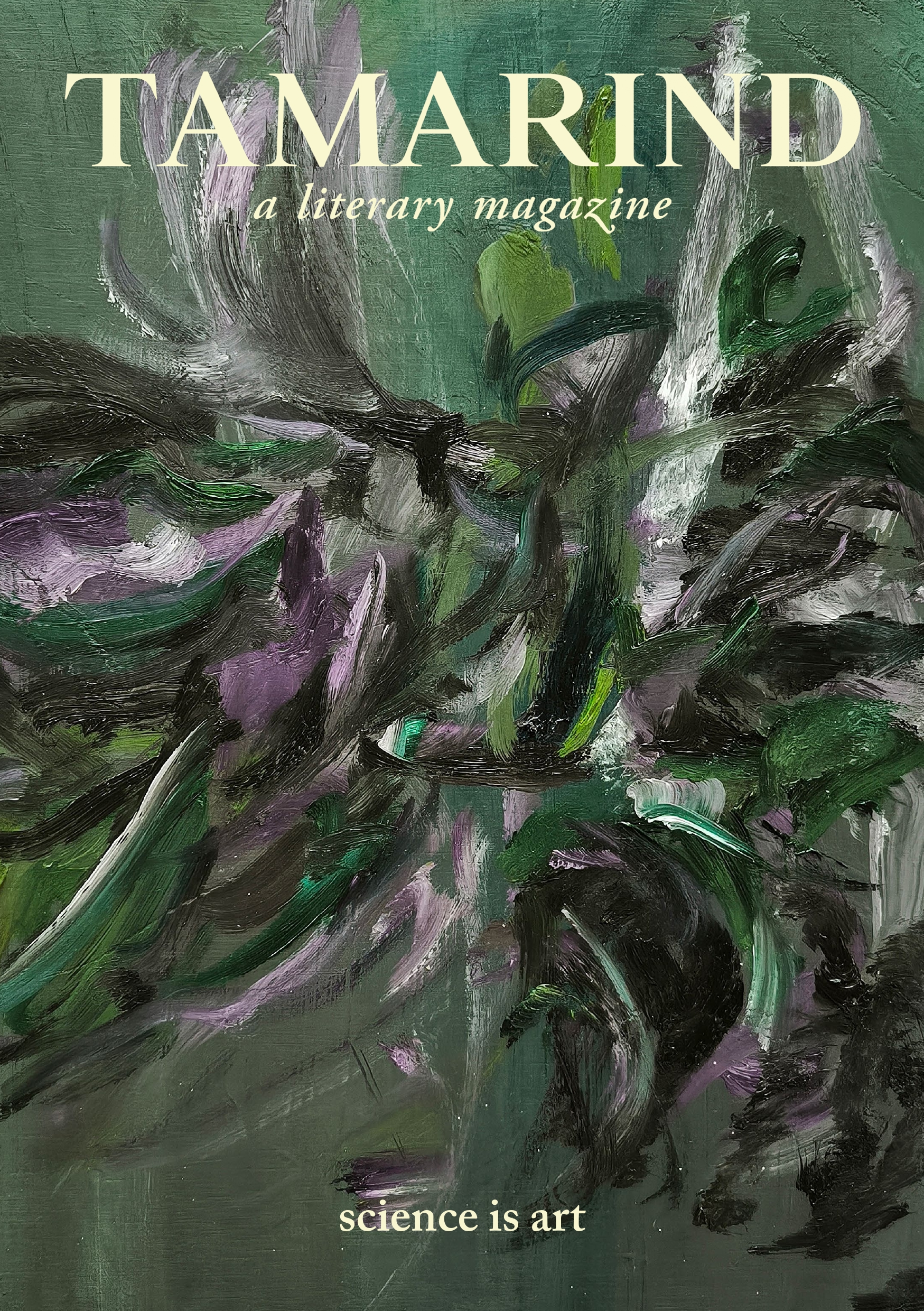
In Issue 9 of TAMARIND, you will find stories that attempt to address the unknown, the undefinable, and the inexplicable. Our contributors push the limits of language; attempt communication between human, machine, and animal; and consider how knowledge passes through generations. This culminates in an interview with poet Harry Josephine Giles, who herself interrogates the boundaries of form and translation in her works, including Them! and Deep Wheel Orcadia. Our cover, by painter James Alfred Hart, draws on the theme of wandering in the woods, stepping into the unfamiliar.
In composing our latest issue, we have had the delight of briefly inhabiting the diverse worlds within. We hope that you can do the same and, in doing so, think in a new way about the shades in which we speak to one another.
The TAMARIND Editors
Issue 8
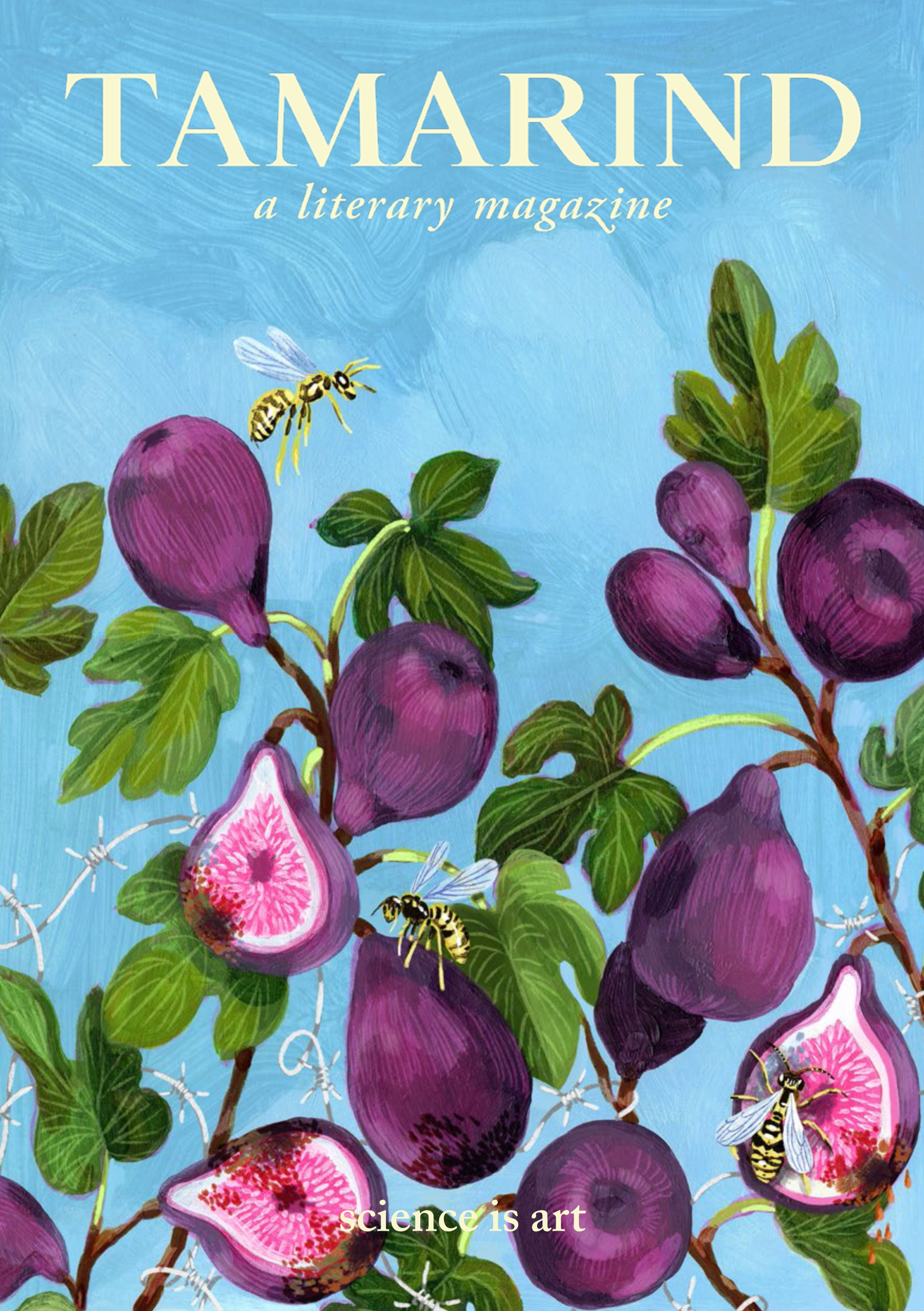
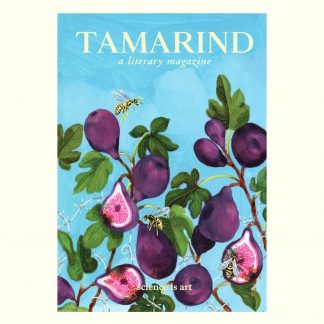
Issue 8 of TAMARIND is now available for purchase in digital and in print. Back issues are also available to buy, while stocks last.
You can read and download current and past issues of the magazine online at read.tamarindlit.co.uk. Just enter your order number, issue number, and email address.
- Viruela, Clara Kiat
- Clara Kiat is a Filipina writer based in Madrid, Spain. Her fiction has appeared in The Masters Review, Puerto del Sol, Flash Fiction Magazine, and The Other Stories. She is working on a novel and a collection of short stories set in 19th century colonial Philippines.
- Marrow, Mary Fontana | @maryfontanawrites (Instagram)
- Mary Fontana trained as an immunologist and did infectious disease research for over a decade before turning to writing full-time. Her first book is forthcoming from Orbis Books. She is a reader for the online lit mag Only Poems, and her writing has appeared in Prairie Schooner, The Seneca Review, Rust + Moth, SWWIM Everyday, Moss, and elsewhere. She lives in Seattle with her husband and two children.
maryfontana.com - Skin, Mel Piper | @tinymel18 (Instagram)
- Mel Piper is a freelance writer based in Coventry whose work focuses on bringing the weird into the everyday. She has been in publications such as Amphibian Journal, Querencia Press, and a Thi Wurd anthology, and has run creative writing workshops for adults and children. Outside of writing, Mel loves the outdoors and is a keen photographer; her work has featured in multiple publications, including Nightingale and Sparrow and Swim Press.
melpiperwriter.wordpress.com - Feeling for the Inanimate, Max Cavitch | max.cavitch (Facebook)
- Max Cavitch is Associate Professor of English at the University of Pennsylvania. His books include American Elegy: The Poetry of Mourning from the Puritans to Whitman (Minnesota, 2007), Psychoanalysis and the University (Routledge, 2025), a new edition of Walt Whitman’s Specimen Days (Oxford, 2023), and, forthcoming from Punctum Books, Ashes: A History of Thought and Substance. His scholarly essays, poems, and public-facing writings have been published in dozens of journals and magazines.
www.sas.upenn.edu/~cavitch - Foothold, D. C. Nobes | @sebon52 (Instagram)
- D. C. Nobes is a physicist, poet, and photographer who, aside from 2 years on Vancouver Island, spent his first 39 years in or near Toronto, Canada, followed by 23 years based in Christchurch, New Zealand, and 4 years in China. He has since retired to Bali. He used to enjoy winter but admits that he doesn’t miss the snow or the cold. He thinks almost all poetry is meant to be read aloud. His poetry and art photographs have been widely published.
- When the Hedgehog Met the Fox, Soramimi Hanarejima
- Soramimi Hanarejima is the author of the story collection Literary Devices For Coping. Her recent work appears in Pulp Literature, Fjords Review, and Black Warrior Review.
cognitivecollage.net - More To, Nick Armbrister
- Born in Oldham, Lancashire, Nick has worked in various jobs from baking to forklift truck work to call centres in South East Asia. He was first published in 1996.
- No One to Bury, Remi Recchia
- Remi Recchia is a Lambda Special Prize-winning poet, essayist, and editor from Kalamazoo, Michigan. An eight-time Pushcart Prize nominee, he is the author of six books and chapbooks and is the editor of two contemporary poetry anthologies. He holds an MFA in poetry and a PhD in English. Remi will begin his MDiv at Yale University in Fall 2025.
- Elliptical ghazal for the man who 3D-printed the Moon, and gave it to me as a lamp, Ellora Sutton
- Ellora Sutton is a poet and PhD candidate based in Hampshire. Her work has been published in The Poetry Review, Berlin Lit, and Propel, amongst others, and she is the poetry reviewer for Mslexia. Her pamphlets include Artisanal Slush (Verve) and Antonyms for Burial (Fourteen Poems).
- Figures on the Seashore, Andreas Smith | [email protected] (Email)
- Andreas Smith lives in County Durham in the north of England and works as an editor. He is a graduate in both mathematics and philosophy. His short stories have been published in a range of UK literary magazines, including MONK, Idle Ink, Storgy, Loft Books, Fiction on the Web, and Shooter Literary Magazine. He has also written several novels, for which he is represented by a London-based literary agency.
andreassmithwriter.com - Reject and Revise, Ravneet Bawa | @onethirdabove.bsky.social
- Ravneet Bawa is a doctoral student at the LSE. Formerly a technology marketer, she now researches consumer decision making. Her poetry appears in The Bombay Literary Magazine, The Bombay Review, Asia Writes, Desi Writers’ Lounge magazine Papercuts, Coldnoon, Literally Literary, and Eksentrika. She was shortlisted for Poetry Society of India’s All India Poetry Competition 2016. She hosts the poetry podcast ‘Ellipsis’. Between poetry and science, one keeps her alive and the other keeps her sane.
medium.com/@onethirdabove - Back to the Roots, Sayani De | @sayani_quill (Instagram)
- Sayani De is an engineer who has working in the tech industry. She writes fiction and creative non-fiction. Her short fiction has been shortlisted for the Purple Pencil Project, 2024, and longlisted for the Commonwealth Short Story Prize 2025. Her work has been featured in several literary magazines including The Bangalore Review, Indian Literature (Ministry of Culture, India), Muse India, The Selkie, and Indian Review. She is working on her first novel and lives in Kolkata, India.
- When Fire Came & Venera, Joseph Buck | @joseph_buck (Instagram)
- Joseph Buck is Southern Californian. He is the former editor of the journal of the Pacific Rim, Boomtown, which still gets citations to this day despite being dark. He had poetry and freelance work published decades ago, but the pandemic and social change drove him to write again. That work has most recently been featured in Anacapa Review.
- E = mc2 and Me, Tom Tierney | @bankphysics.bsky.social
- Tom Tierney has published short fiction in the Stinging Fly, The London Magazine, Litro, and elsewhere, alongside non-fiction in Physics World and New Scientist. He is a physics teacher in Dublin and also wrote a widely used physics textbook for second level students in Ireland.
physicsresourcebank.com - In Conversation with Helen Gordon
- Helen Gordon is a writer and natural historian. Her books include The Meteorites (Profile), Notes from Deep Time (Profile), and Landfall (Penguin), a novel. She has written for, among others: 1843 magazine, The Guardian, and Wired; edited for Granta; and teaches Creative Writing at the University of Hertfordshire.
EDITORIAL
From splitting the atom to editing genes, science often presents both the promise of a brighter future and the threat of unknown dangers. We see this today in the apprehension surrounding AI, bioengineering, the colonisation of space, and countless other areas of advancement. In this issue of TAMARIND, we examine faith and fear in science: how it can be used both to liberate and to oppress.
Issue 8 does not only include prose, but also — for the first time — poetry. Through form, rhyme, and meter, poetry provides a unique canvas for examining science as a human endeavour. We are thrilled to be able to include it, working alongside poet and science communicator Jack Cooper. We feel this is a long overdue addition to TAMARIND, and we hope you appreciate it as much as our usual selection of short stories, essays, art, and an interview (this time with Helen Gordon, author of Notes from Deep Time and The Meteorites). We are also delighted to welcome back Issue 1 cover artist, Joanna Clay, marking a new beginning for TAMARIND.
We hope that this issue of TAMARIND equips you, in some small way, to tackle the challenges ahead and, as ever, we hope you enjoy it.
The TAMARIND EditorsIssue 7
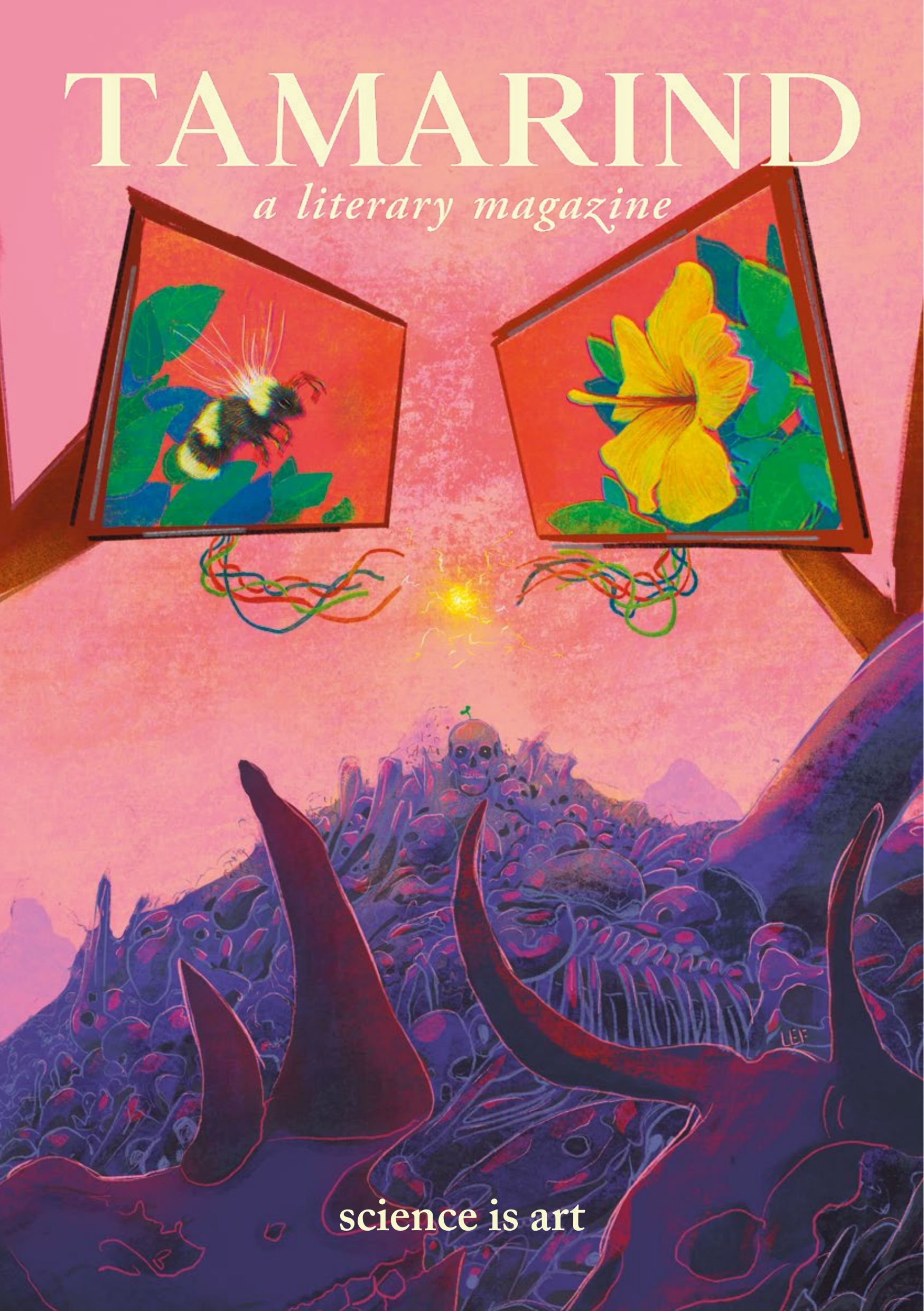
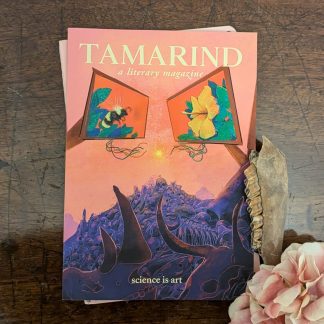
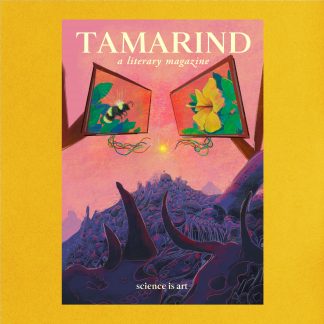
Issue 7 of TAMARIND is now available for purchase in digital and for pre-order in print. back issues are also available to buy, while stocks last.
You can read and download current and past issues of the magazine online at read.tamarindlit.co.uk. Just enter your order number, issue number, and email address.
- The Ripening, Sayani Sarkar | @theomnivorescientist (Instagram)
Sayani Sarkar is a reader, reviewer, and writer from Calcutta, India with a PhD in biochemistry and structural biology. She writes academic book reviews on her Substack and her works have been published in LARB PubLab Magazine, Littera Magazine, The Write Launch, The Coil Magazine, and The Curious Reader. She is currently working on a book, a hybrid nonfiction, combining memoir with an exploration of natural sciences.
sayanisarkar.substack.com- Forest Stratum, Jade Doyle | @_jademdoyle (Instagram)
Jade Doyle is a writer who creates on the unceded lands of the Jagera people. She graduated from the University of Southern Queensland with a Distinction in English Literature and Creative and Critical Writing. Jade’s work has appeared in Voiceworks, Island, Corvid Queen, and the Australian Poetry Anthology 2023.
- The Lion and the Lamb, David Sheskin
- David Sheskin is a former university professor and the author of The Handbook of Parametric and Nonparametric Statistical Procedures (Chapman and Hall). Most recently he has appeared in The Journal of Humanistic Mathematics, The Font, Palooka, and DIAGRAM. His most recent books are David Sheskin’s Cabinet of Curiosities and Outrageous Wedding Announcements.
sheskinart.my.canva.site
- David Sheskin is a former university professor and the author of The Handbook of Parametric and Nonparametric Statistical Procedures (Chapman and Hall). Most recently he has appeared in The Journal of Humanistic Mathematics, The Font, Palooka, and DIAGRAM. His most recent books are David Sheskin’s Cabinet of Curiosities and Outrageous Wedding Announcements.
- On Time, Akshay Gajria | @akshaygajria (Instagram)
Akshay Gajria is a London-based storyteller, writer, and writing coach. He has a bachelor’s in computer engineering from NMIMS, Mumbai and a master’s in creative writing from Birkbeck, University of London. His work has appeared in Skulls, The Writing Cooperative, The Written Circle, Bluegraph Press, The Coffeelicious, Your Story Club, Futura Magazine, The Book Mechanic, Poets Unlimited, StoryMaker, Whiplash, and more.
akshaygajria.com- The Boy that Buys the Beef, Jonathan Doering | jonathan.doeringwork.9 (Facebook)
Jonathan Doering was born in Stockport in 1975 and lives in Nottingham with his family. He has lived, studied, and worked in Britain, Ireland, Japan, and France. He holds master’s degrees in creative writing and Quaker Studies. His work has appeared in a variety of places, including Contemporary Review, Poetry Manchester, The Guardian, Oxford Life, The Yorkshire Times, and LeftLion. A book of dialogues about racial justice, Enlarging the Tent, co-authored with Dr Nim Njuguna, is published by Collective Ink.
- Aurora, Francesca Carra
Francesca Carra is a London-based writer. She writes short fiction and is currently working on a novel.
francescacarra.com
- Ruggero Oddi’s Last Letter, Eli Ehrenpreis
- Eli Daniel Ehrenpreis started life as a musician and became a physician, educator, and researcher. He stopped seeing patients after major surgery. He has published many scientific papers and six medical books. His poetry and short stories are published in Reapparition, Pharos, Medicine and Meaning Journal, Hektoen International, 101 Words, and Star 82 Review. He lives with his wife Ana and a little dog named Fili in Skokie, Illinois.
- Non-Human Narratives, Jennifer McCormack
Jennifer McCormack is writer and artist based in Malmo, Sweden. As a part of the Stpln creative hub she leads a breathwork and poetry walk together with Jagadeesh Arunachalam. She studied English at The University of Glasgow. Her writing has featured in New Writing Scotland, Amsterdam Review, and Ordkonst magazine, among others.
cityofpoets.com/team/jennifer-mccormack- New Fruit, Rebecca Heilweil
Rebecca Heilweil is a writer from and based in New York City.
- In Conversation with Louisa Hall
- Louisa Hall is an Assistant Professor of Creative Writing at the University of Iowa and the author of the critically acclaimed novels Reproduction, Trinity, and Speak. Her poems have been published in The New Republic, Southwest Review, and other journals, and she is the recipient of grants from Yaddo, Macdowell, and The T. S. Eliot Foundation. She lives in Iowa City with her family.
EDITORIAL
We are waging war on ourselves. Reproductive rights are under threat around the world, militarisation is accelerating no matter the cost, and so-called artificial ‘intelligence’ is being used to undermine the very process of creation which makes us human. All of this is happening against the backdrop of a mass extinction accelerated by climate change. This world fills many of us with a sense of unease about what life we, as a species, are destroying and what sinister pseudo-consciousnesses we may be giving birth to.
In this context, the authors and artists of Issue 7 of TAMARIND explore the twin themes of bodies and consciousness: considering minds that exist beyond human bodies, rudely contending with the limits of biology, and examining the violence we enact on the bodies of others.
In addition to the short stories and essays in this issue, we are delighted to feature a cover from Athens-based artist Lef Apostolakis and an interview with Louisa Hall, whose novels — including Reproduction (2023) and Trinity (2020) — use science as a tool for interrogating our own lives and histories. We hope that, in Issue 7, you also find tools with which to make sense of a world in which our humanity is diminishing.
The TAMARIND Editors
Issue 6
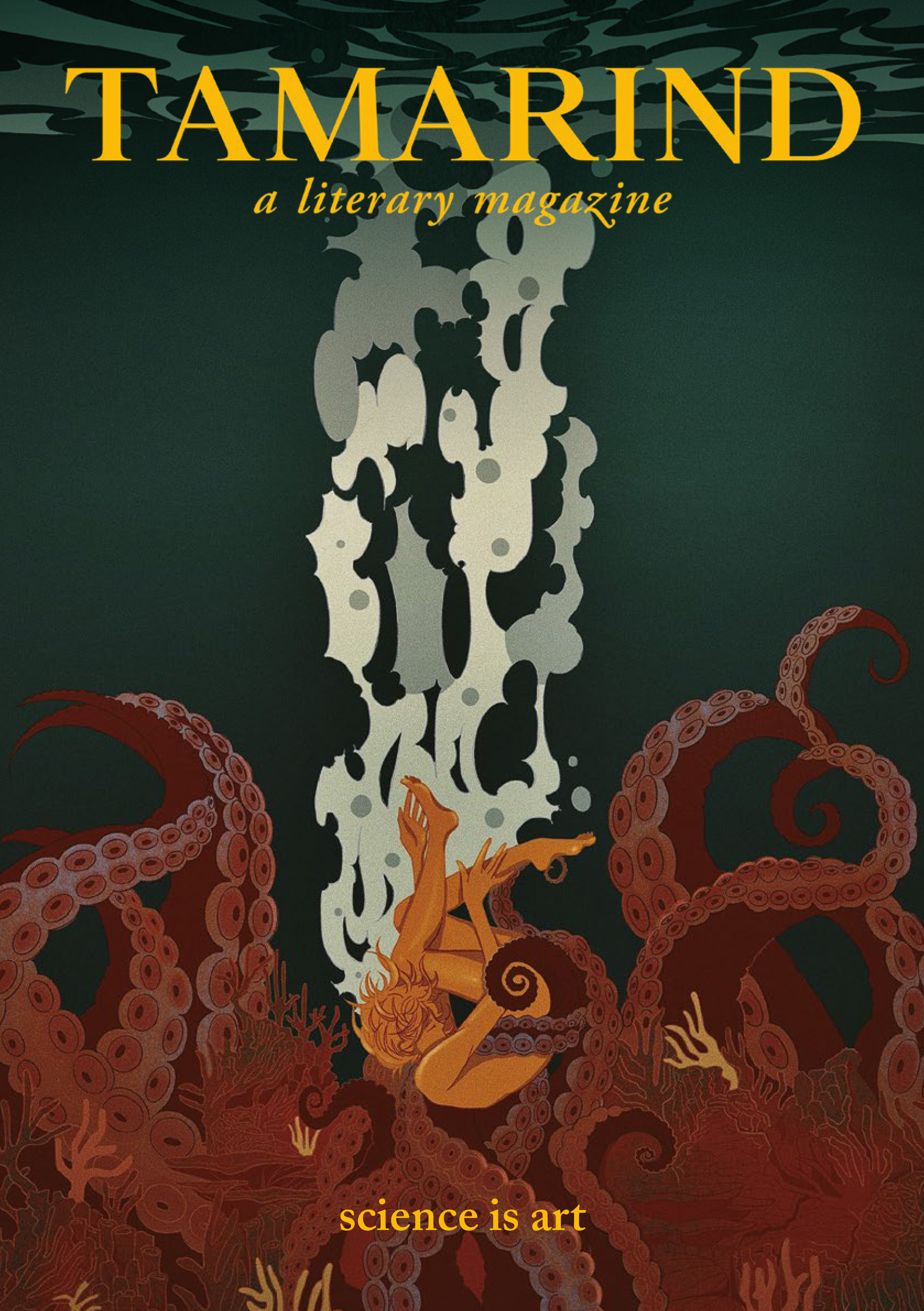
Issue 6 of TAMARIND is now available for purchase in digital and for pre-order in print. All previous issues except issue 5 are also available to buy, while stocks last.
You can read and download current and past issues of the magazine online at read.tamarindlit.co.uk. Just enter your order number, issue number, and email address.
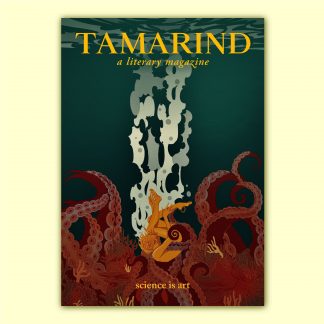
- Sal, Griffith Pound
- Griffith Pound is a new writer of speculative and literary fiction. His work has appeared in the Mobius Blvd Book 2 anthology and online in Academy of the Heart and Mind, Ariel Chart, and Down in the Dirt. When not writing, Griffith is the father of three sarcastic but wonderful teenagers, the owner of an energetic border collie, and a slave to a cat.
- Wild Blue Yonder, Daniel Hesk | @daniel.hesk (Instagram)
- Born and raised in rural Scotland, Daniel moved to London in 2022 to pursue a degree in physics at Imperial College. He reads strange books and writes short fiction in his spare time.
- Error, Vanessa Hayes
- Vanessa Hayes is a science educator and communicator living in California, USA. She received an MSc in Science Communication from Imperial College London in 2023, and wrote and edited for Imperial’s magazine, I, Science, and their science radio station, Mission Impossible, in her time there. ‘Error’ is her creative writing and short story debut.
- A Rectifiable Arc, Shelly Jones | @shellyjansen (Twitter)
shellyjonesphd.wordpress.com - Shelly Jones (they/them) is a professor at a small college in upstate New York, where they teach classes in mythology, folklore, and writing. Their speculative work has been published in F&SF, The Future Fire, and elsewhere.
- Dead Man’s Fingers, Rekha Valliappan | @silicasun (Twitter)
silicasun.wordpress.com - Rekha Valliappan is an award winning writer of short fiction, poetry and creative nonfiction. Her writing has featured in diverse journals and anthologies, including Litro Magazine, Lackington Magazine, The Cabinet of Heed, The Museum of Americana: A Literary Review, The Blue Nib, and All Your Stories Magazine.
- Raising Morels, Tara K. Ross | @tara.k.ross (Instagram)
tarakross.com - Tara K. Ross is a writer, podcaster, and audiobook narrator based in Southern Ontario. She is vice-chair of the board for the Eden Mills Writers’ Festival and co-host of The Hope Prose Podcast. Her debut novel, Fade to White, was published in 2020. Her fiction and essays have also appeared in Wells Street Journal, Grace Go Bloom, and Love is Moving. When she’s not adulting, Tara is climbing the Ontario escarpment and working on her next novel in her cabin in the woods.
- Enfender’s Folly, David Sheskin
sheskinart.my.canva.site - David Sheskin is a former university professor and the author of The Handbook of Parametric and Nonparametric Statistical Procedures (Chapman and Hall). Most recently he has appeared in The Los Angeles Review, The Journal of Humanistic Mathematics, The Font, The Dalhousie Review, and Cleaver Magazine. His most recent books are Art That Speaks, David Sheskin’s Cabinet of Curiosities, and Outrageous Wedding Announcements.
- Experimental Film, Joe Oswald | @joemoswald (Instagram)
- Joe Oswald is a writer and photographer based in London.
- In the Eye of the Moon, Sylvie Jane Lewis | @sylviejanelewis (Instagram)
- Sylvie Jane Lewis writes fiction and poetry, and has an English master’s from Cambridge. In 2023, she was winner of the CUPPS Prize and runner-up of the Sykes Prize. Her work has appeared in various publications, including Ink Sweat and Tears, Feral Journal, and Spinozablue.
- Not from an Astronomer, Meredith Miller | @FallRiverUK (Instagram)
meredithmiller.me - Meredith Miller was born in Long Island, New York, and has lived in the UK since 1997. She is the author of three published novels and numerous short stories, as well as literary criticism focusing on gender, sexuality and fiction. Her most recent novel, Fall River (Honno Press), was published in March 2024.
- White as Bones, Yuxin Zhao
- Yuxin Zhao is a writer from Hangzhou, China, currently based in the UK. Yuxin mainly writes experimental fiction and poetry on immigration, language, family history, and queer desire. Yuxin’s debut novel, The Moons: Fire Rooster to Earth Dog, is available now (Calamari Archive).
- In Conversation with Martin MacInnes
- Martin MacInnes is a multi-award-winning writer based in Edinburgh. His most recent novel, In Ascension, is being translated into nine languages and has been optioned for film.
EDITORIAL
Over the past months, the prospect of crises spiralling out of control – ecological, economic, and geopolitical – has left us with the feeling of standing on the precipice of madness. When expert voices form a cacophony, it is impossible to know whether dread for our future is rational.
This sense of a vast – perhaps terrible – unknown pervades TAMARIND Issue 6, which travels from the age of the dinosaurs to the climate-ravaged future. In their encounters with the unknown, characters are sometimes charmed, sometimes horrified, but seldom do they escape unchanged. The issue ends with an interview with Scottish author Martin MacInnes, whose Booker-longlisted novel In Ascension explores this very theme with breathtaking skill and ambition.
TAMARIND continues to examine through literature those questions that we consider evergreen for science. How is the experience of science different for ‘outsiders’? Can science deepen our understanding of ourselves? And which questions is science ill-equipped to answer?’
This issue marks a fresh start for TAMARIND, with a new layout by designer Lydia Blagden. Alongside the authors’ contributions, it features original art from Jane Meng and photography from Angel Li. We are very proud of this issue and what our contributors have to share – we hope they speak to you as much as they did to us.
The TAMARIND Editors
Issue 5
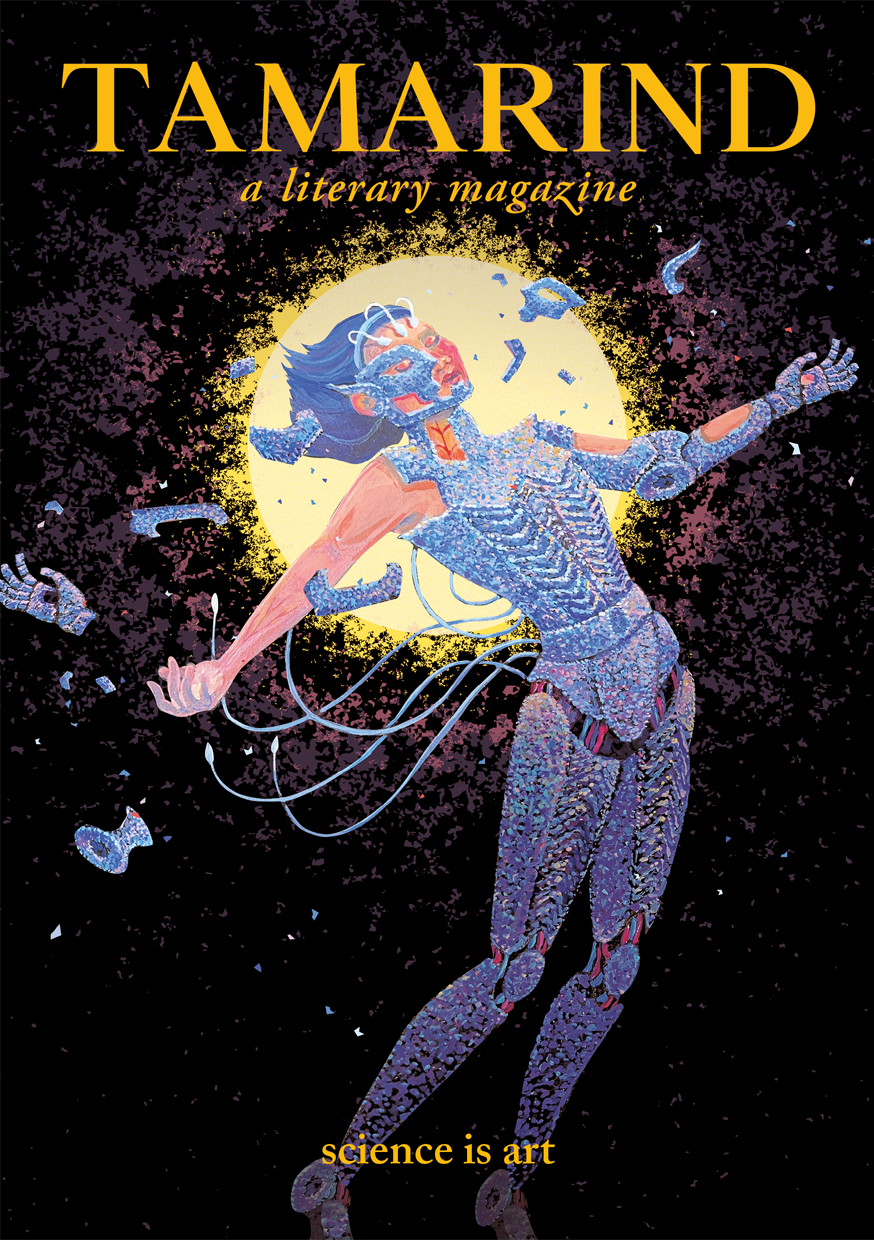
Issue 5 of TAMARIND is now available for purchase in digital and for pre-order in print. All previous issues are also available to buy, while stocks last.
You can read and download current and past issues of the magazine online at read.tamarindlit.co.uk. Just enter your order number, issue number, and email address.
Poetry in a Petri Dish: Meeting Sudeep Sen, Jhilam Chattaraj
Jhilam Chattaraj is an academic and poet based in Hyderabad, India. Noise Cancellation is her latest collection of poems. Her works have appeared at Calyx, Room, Colorado Review, Ariel, and World Literature Today, among others.
Mercy, Angie Lo
Angie Lo is currently doing an MSc in Science Communication at Imperial College London. She is a reviewer for Consilience and has had poetry featured in several publications, including The Trinity Review and Acta Victoriana. ‘Mercy’ is her debut short story.
Back and Forth with Oscar Wilde’s Son, Mandira Pattnaik
Mandira Pattnaik is the author of collections Anatomy of a Storm-Weathered Quaint Townspeople, Girls Who Don’t Cry, and Where We Set Our Easel. Mandira’s work has appeared in a variety of magazines and journals. She writes columns for Reckon Review, and edits for trampset and Vestal Review.
The Portico Library: Lights, Alicia Sometimes
Alicia Sometimes is a poet, multi-media artist, and broadcaster. In 2021 she completed the Boyd Garret residency for the City of Melbourne and a Virtual Writer in Residency for Manchester City of Literature and Manchester Literature Festival. She is director and co-writer of two science-poetry planetarium shows.
If There Is a God in Heaven You Shall Surely See Him, David Sheskin
David Sheskin is a former university professor of psychology. A writer of fiction and an artist, his work has been published extensively over the years. His most recent books are Art That Speaks, David Sheskin’s Cabinet of Curiosities, and Outrageous Wedding Announcements.
Under a Full Earth, Anthony Regolino
A Finalist in 2020’s 1st Quarter of the Writers of the Future Contest, Anthony Regolino has had his fiction and poetry included in various anthologies devoted to fantasy, horror, science fiction, crime, and comedy. He worked as an editor, ghostwriter, contributing writer, and has composed blogs professionally for major companies’ websites.
The Intersect of Poetry and the Chemical Sciences, Stephen Paul Wren
Stephen Paul Wren worked in industry for many years and is currently senior lecturer in pharmaceutical chemistry at Kingston University in 2018. His poetry has been published in a variety of magazines and he has co-authored two books. Stephen also runs a Facebook group, Molecules Unlimited.
The Cost of Helium, Kinneson Lalor
Kinneson Lalor is a mathematician and writer living in Cambridge, UK with her chickens and her dog. She has a PhD in Physics and an MSt in Creative Writing. Her collaborative poetry collection about Alan Turing and AI, Machinations, was published by Trickhouse Press in 2022.
In Conversation with Rob Appleby
Rob Appleby is a professor of physics at the University of Manchester and a member of the Cockcroft Institute of Accelerator Science and Technology. His science communication work has spanned projects with authors and film-makers; informal engagement in unusual spaces; and the use of music, sound and art to communicate science. He has worked on many books with Comma Press as an editor and consultant, including Litmus, When It Changed, and Thought X. His latest book with Comma Press, Collision, brought together authors with CERN physicists and engineers to create an anthology of short stories inspired by the organisation and its famous laboratory.
EDITORIAL
Across countless languages, light is a metaphor for knowledge and darkness for ignorance. Scientific knowledge, in particular, is characterised as a guiding light for humanity in times of profound change: ‘a candle in the dark’.
Over the past year, the foundations of the world have been rocked by the mass adoption of generative artificial intelligence tools like Midjourney, Stable Diffusion, and ChatGPT. Nothing seems certain. We are being forced to re-examine where to draw the line between the artificial and the human; how to distinguish truth from falsehood; and what our relationship with labour could be. Science can help shed light on these questions, alongside other disciplines like philosophy, art, and poetry.
In Issue 5, we join these conversations with literary explorations of artificial intelligence and other topical subjects. In these short stories, we travel from French Pondicherry during the ravages of the Great War to a space colony of the near future. We examine the relationship between science and literature with three essays suffused with poetry, and with an interview with particle physicist Professor Rob Appleby, co-editor of the experimental anthology Collision: Stories from the Science of CERN. The themes in Tamarind Issue 5 are also explored in excellent illustrations and photography from Ling-Hsuan Wang and Angel Li.
We hope you find Tamarind Issue 5 as thought-provoking as we do, and that it can be one of many candles for you in this uncertain times.
The Tamarind Editors
Issue 4
Issue 4 of TAMARIND is now available for purchase in both print and digital. Issues 1, 2, and 3 are also available to buy, while stocks last.
You can now read and download current and past issues of the magazine online at read.tamarindlit.co.uk. Just enter your order number, issue number, and email address.
Aftermath, Lucy Zhang
Lucy Zhang writes, codes, and watches anime. Her work has appeared in The Willowherb Review, Interzone, Hayden’s Ferry Review, and elsewhere. She is the author of the chapbooks Hollowed (Thirty West Publishing, 2022) and Absorption (Harbor Review, 2022).
Digging Deep, Gary Grossman
Gary Grossman is Professor Emeritus of Animal Ecology at University of Georgia. His writing has appeared in over 30 literary reviews. Gary’s poetry book, Lyrical Years, is forthcoming (2023) from Kelsay Press, and his graphic novel My Life in Fish: One Scientist’s Journey, is imminent.
Wunderlich Park, Robert Trotta
Roberto Trotta is Professor of Astrostatistics at Imperial College London, currently on leave of absence to the International School of Advanced Studies in Trieste, Italy, where he is the head of Data Science. An award-winning author and science communicator, he is the recipient of the Annie Maunder Medal 2020 of the Royal Astronomical Society for his public engagement work.
Patience, Nancy J Fagan
Nancy J Fagan’s work can be found in Coolest American Stories 2023, Fiction International, Nifty Lit, and The Bangalore Review, among others. She is a registered nurse, has a BA from Mount Holyoke College, and an MFA in Writing from the Vermont College of Fine Arts. A US-based writer, she is revising her debut novel and loves writing historical, often medically themed, fiction.
Nyengu: Time, Weather, and Seasons in Malawi, Megan Ewald
Megan Ewald is a science communicator and writer based in Washington, DC. She served as a Peace Corps Volunteer in Malawi working in forestry and food security. Her work has appeared in Flyway, the Maritime Executive, and Unearthed.
The Fattening, Jean Gismervik
Jean Gismervik lives in Westchester, NY, where she works as a Director of Special Education. Her writing has appeared in Rolling Stone online (rollingstone.com), Urb Magazine, and You Give Me the Sun (St. Mary’s Press). She is currently working on a novel about New York City that examines themes of memory, time, and climate change.
Napoleon’s Chronometer, Thomas Belton
Thomas Belton is an author with publications in fiction, poetry, non-fiction, magazine feature writing, science writing, and journalism. He has been published many times, including for the journals Fteroa Logia, Mystery Weekly, Mystery Tribune, Constellations, South Shore Review, The Satirist, Adelaide, Meet Me at 19th Street, Cicada, and Art News. His professional memoir, Protecting New Jersey’s Environment: From Cancer Alley to the New Garden State (Rutgers University Press) won Best Book in Science Writing for the General Public by the New Jersey Council for the Humanities.
You Are What You Eat, David Sheskin
David Sheskin is a former university professor of psychology (with a specialisation in statistics and experimental design), and the author of The Handbook of Parametric and Nonparametric Statistical Procedures (Chapman and Hall). A writer of fiction and an artist, his work has been published in numerous magazines such as The Dalhousie Review, Puerto del Sol, The Satirist, and the Journal of Irreproducible Results.
Sawdust, Daniele Swetnam
Daniele Swetnam is passionate about exploring the relationship between the environment and virus evolution. She has a PhD in Microbiology and Immunology from the University of Texas Medical Branch and, when she isn’t nurturing experiments in the laboratory, she is analysing data in the quiet pockets of her historic island town or chasing bubbles with her family at the beach.
In Conversation with James Poskett
James Poskett is the author of Horizons: The Global Origins of Modern Science. Poskett is Associate Professor of the History of Science and Technology at the University of Warwick. He writes about the global history of science and technology, ranging from 17th century physics to 20th century biology. In 2013, he was shortlisted for the BBC New Generation Thinker Award.
Editorial
We brought together our fourth issue against the backdrop of what feels like perilous global instability; it is through this lens that many of our contributions can be seen. The voices in this issue echo our shared anxieties and call for a compassionate and humane understanding of science: one that works for us all.
Reverence for nature also runs throughout this issue, perhaps provoked by the catastrophic realities of climate change unfolding before our eyes. Fear for Earth’s future is reflected in several of our contributions, many of which investigate our symbiotic relationships with the Earth, nature, and other living things. With this in mind, Issue 4 of TAMARIND invites you to search for nourishment — physical, intellectual, and emotional — in the world around you.
In this issue we have essays from Nkhata Bay, Malawi, to the West Coast of the US; and stories which traipse through history, examine the shortcomings of competitive academia, and speculate about dystopian futures. This is rounded up by a fascinating Q&A with James Poskett, historian and author of Horizons, as he makes the case for a global history of scientific discovery.
We are so proud of TAMARIND Issue 4, and we hope you find it as thought-provoking, illuminating, and moving as we do.
The Tamarind Editors
Issue 3
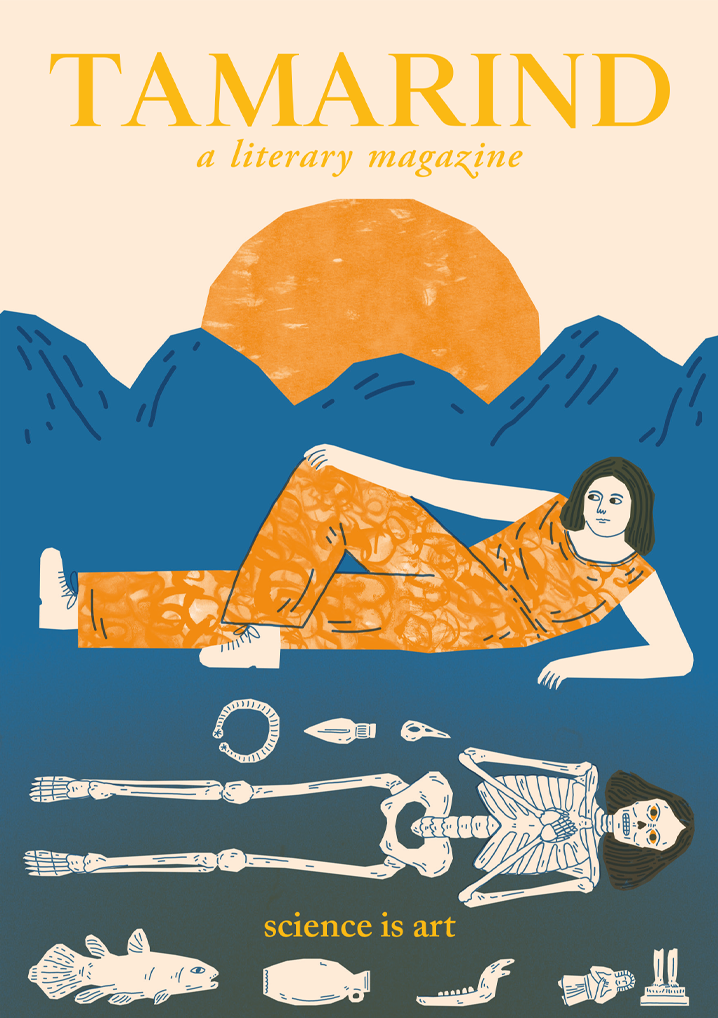
Issue 3 of TAMARIND is now available for purchase in both print and digital. Issues 1 and 2 are also available to buy, while stocks last.
You can now read and download current and past issues of the magazine online at read.tamarindlit.co.uk. Just enter your order number, issue number, and email address.
Considering the Role of the Female, Pippa Goldschmidt
Pippa Goldschmidt is a writer based in Edinburgh and Frankfurt. Her work includes Uncanny Bodies, The Need for Better Regulation of Outer Space, I Am Because You Are, and The Falling Sky, her debut novel.
The Love of Lucy Ossa, Henry Bennie
Henry Bennie is science communicator and writer currently exploring quantum technologies at UCL. He lives in Bristol where he thinks a lot more about writing his first novel than actually writing his first novel.
Notes of a Naturalist, Thomas Belton
Thomas Belton is an author with publications in fiction, poetry, non-fiction, science writing, and journalism. He is also a frequent columnist for the New York Times, The Baltimore Sun, and The Philadelphia Inquirer.
Daddy’s Girl, Toshiya Kamei
Toshiya Kamei is a fiction writer working in English and Spanish. His short fiction has appeared in venues such as New World Writing, Revista Korad, and SmokeLong en Español.
Fighting the Bad Fight, Susan Lymen
Astrid’s Brain, Charlotte Crowder
Charlotte Crowder lives and writes on the coast of Maine in the US. She is a medical writer and editor by day. Her publications include stories in Intima, Branching Out: International Tales of Brilliant Flash Fiction, American Writers Review, and A Fine Orange Bucket (North Country Press).
Beyond their Time, Tristan Marajh
Tristan Marajh is a writer with work in a number of magazines, including Existere, The Bombay Review, Blank Spaces Magazine, The Nashwaak Review, and Ricepaper Magazine. Originally born in Trinidad and Tobago, he now lives in Toronto.
In Search of Nature, Anthea Lacchia
Anthea Lacchia is a freelance science and nature writer, and a journalist. She has a PhD on fossil ammonoids, extinct relatives of squid and cuttlefish. Her writing has appeared in The Guardian, Nature, Research Professional, and The Irish Times. She lives in Ireland, where she can often be found outside, hiking and birdwatching.
In Conversation with Benjamín Labatut
Benjamín Labatut is a Chilean writer. Born in Rotterdam, he spent his early youth in The Hauge and Buenos Aires before moving to Santiago. He has written several award-winning books, including La Antartica empieza aqui (Antarctica Starts Here) and Un verdor terrible (When We Cease to Understand the World), the latter of which was nominated for the 2021 International Booker Prize.
Editorial
We all leave things behind: past versions of ourselves, things we create and share, and, eventually, whatever remains of our bodies when we die. Scientists and artists can have particularly long-lasting legacies; we remember the names of those who helped to cure deadly diseases, or those that created works that capture the imaginations of subsequent generations.
In this issue of TAMARIND we have a collection of enchanting short stories and non-fiction pieces examining what is left behind when we go. We travel from the distant past to the near future, sit with grief and love, and examine legacies both lost and found. We also speak with 2021 International Booker Prize nominee Benjamín Labatut, author of Un verdor terrible (When We Cease to Understand the World), about his creative process.
We are delighted to share this issue with you, beautifully illustrated by artist Benji Spence. As ever, we hope you enjoy reading it as much as we enjoyed making it.
Gautam Kambhampati
Editor
Issue 2
Issue 2 of TAMARIND is now available for in both print and digital. Issue 1 is also available to buy, while stocks last.
Outside the Box, Holly Day
Holly has been an instructor at the Loft Literary Center in Minneapolis since 2000. Her writing has recently appeared in Hubbub, Grain, and Third Wednesday, and her newest books are The Tooth is the Largest Organ in the Human Body, Book of Beasts, Bound in Ice, and Music Composition for Dummies.
hollylday.blogspot.com
The Symphony of the Atoms, Patricia Contreras Tejada
Patricia is a scientific communicator based in Spain. Her PhD in quantum technologies left her with the urge to connect science and society, which she endeavours to do through her writing and activism.
The Party, Tania Hershman
Tania is a former writer in residence in a biochemistry lab at the University of Bristol and the author of a poetry collection, two poetry pamphlets, three short story collections and a hybrid book inspired by particle physics, and co-author of On This Day She. Her second poetry collection, Still Life With Octopus, will be published in July 2022.
taniahershman.com | @[email protected]
What Came out of the Box, Aviva Treger
Aviva studied Ancient History at University College in London then later trained as an actor with Questors Theatre in Ealing. She recently returned to her home town of Hastings and finds its landscape to be an inspiration for strange stories.
@[email protected]
In the Optical Afterglow, Lucy Durneen
Lucy is a writer and editor for the literary journal Short Fiction, based in the South West of England. She has been published in journals including Poetry Ireland Review, Two Thirds North, Litro, The Stockholm Review of Literature, and World Literature Today.
lucydurneen.com
Perhaps, Dan Brook
Dan teaches in the Department of Sociology and Interdisciplinary Social Sciences at San Jose State University in California, from where he organizes the Hands on Thailand program. His most recent book is Harboring Happiness: 101 Ways To Be Happy.
The Natural Point of View, Thomas Belton
Thomas is an author with publications in fiction, poetry, non-fiction, science writing, and journalism. He is also a frequent columnist for the New York Times, The Baltimore Sun, and The Philadelphia Inquirer.
The Intertidal Zone, Melody Hessing
Melody has taught Sociology and Environmental Studies in colleges and universities in British Columbia. Her academic publications include articles and textbooks, including This Elusive Wild: Women and the Canadian Environment and Canadian Natural Resource and Environmental Policy. She writes creative non-fiction to further explore the intersections of science, society and nature and to celebrate the natural world whose preservation she is passionate about.
Doppler Effect, Kasia Kokowska
Kasia graduated with a degree in journalism and social communication from the University of Warsaw. She moved to Scotland in 2006, and from 2011 to 2019 she coordinated a community project aimed at promoting Polish literature in Scotland. She currently works at the University of Edinburgh as marketing, communications and outreach manager and writes fiction and non-fiction in English and her native Polish.
In Conversation with Aifric Campbell
Aifric is an Irish novelist based in the UK. After thirteen years as an investment banker, during which she became the first female managing director on the London trading floor, she turned to writing full time. Her latest book, The Love Makers, explores the impact of AI and robotics on love, pairing her novel with essays by expert contributors. She teaches creative writing at Imperial College London.
aifriccampbell.com | @[email protected]
Editorial
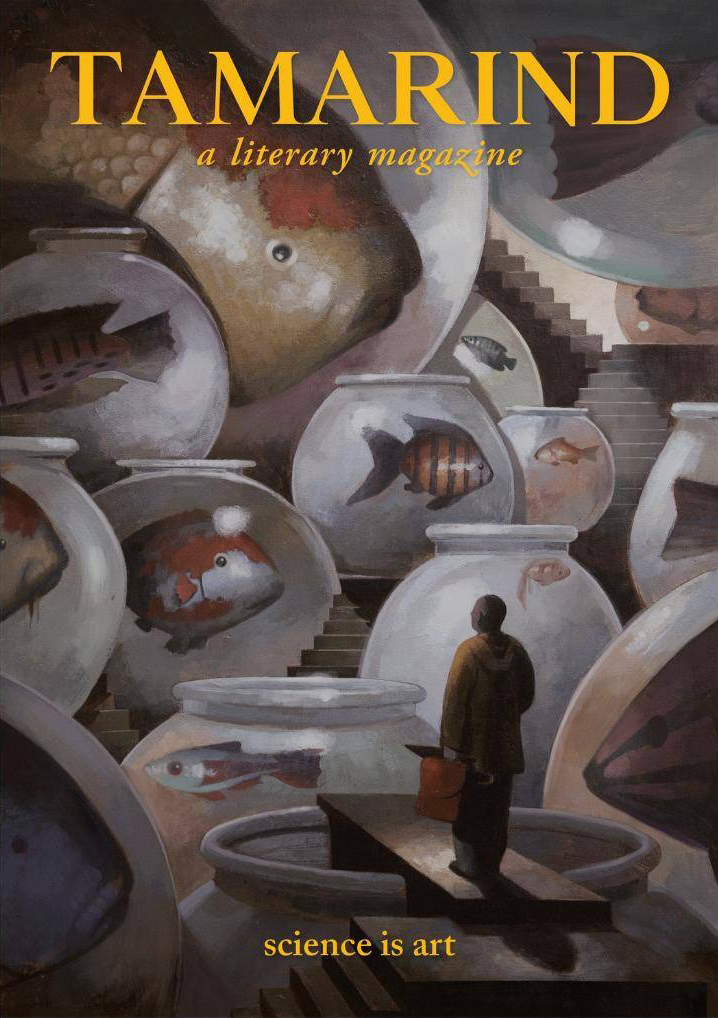
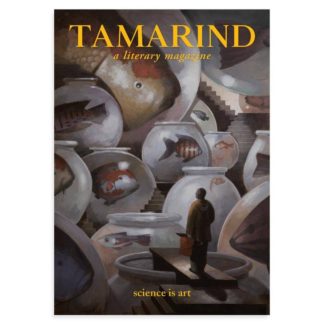
TAMARIND is a magazine about finding the art in science. In our second issue, this mission is explored in pieces that observe a moment in time from multiple perspectives and multiple realities. Our stories and essays are a vivid showcase of different writing styles: from a portrait of scientists in a dream-like Pisa, to an essay which uses unusual narrators to reframe the climate change discussion. The theme has been beautifully captured by our cover artist, Ryan de Carte, who left us with the thought that when you look into a fishbowl, you are seeing the fish’s whole universe, but when the fish looks back, it sees only a fragment of yours.
We’re all very proud of this collection and have been honoured by the quality and breadth of the submissions received. We feel that it represents a crystallisation of our mission to remove the barriers between art and science, and we hope you do too.
Gautam Kambhampati
Editor
Issue 1
God Glows, Tania Hershman
Tania is a poet, writer, teacher, and editor based in the North of England.
taniahershman.com | @taniahershman
The Covid-19 Pandemic, Marianne Bradley
Marianne is a junior doctor for NHS England.
Miranda Blue, Romana Guillotte
Romana is a writer based in the USA.
Lossy Compression, Thomas Willemain
Thomas is Professor Emeritus of Industrial Systems Engineering at Rensselaer Polytechnic Institute.
tomwillemain.com
Physics is a Humanism, Jonathan Beesley
Jonathan is a PhD student in theoretical physics at Imperial College London.
Nucleus, Laurence Klavan
Laurence is a playwright and author. He has written musicals, plays, novels, short stories, and graphic novels.
laurenceklavan.com
In Conversation with Pippa Goldschmidt
Pippa is a writer based in Edinburgh and Frankfurt. Her new anthology, Uncanny Bodies, a collection of fiction, poetry and academic writing inspired by the uncanny is out now.
pippagoldschmidt.co.uk | @goldipipschmidt
Editorial
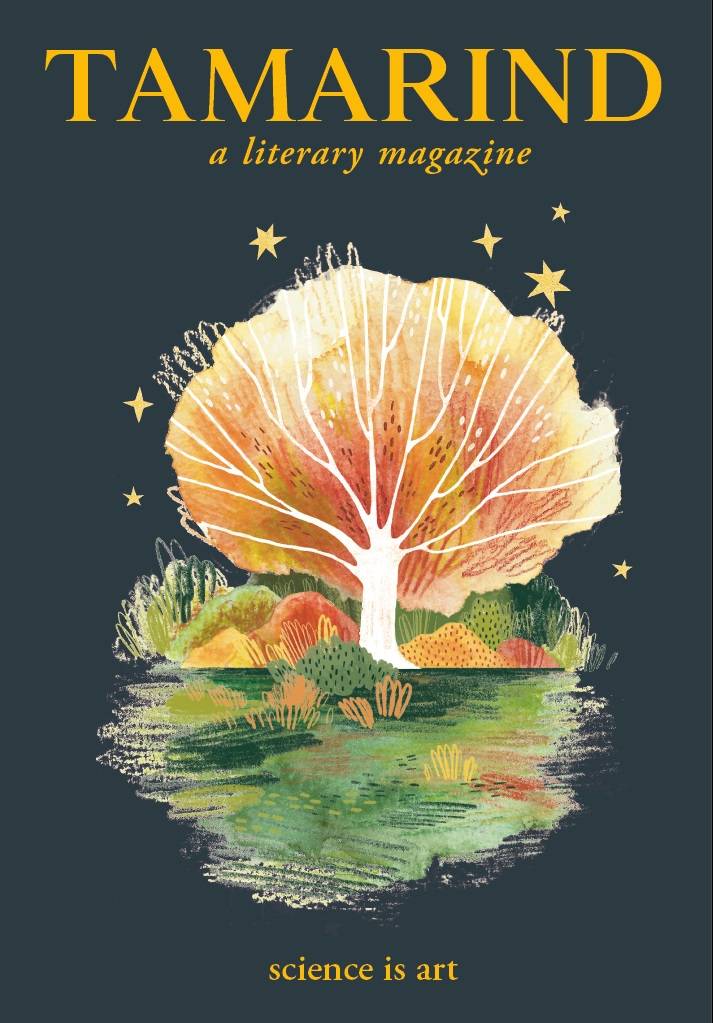
When we had our first meeting with our designer, Cerys, she asked us to describe the magazine in one line. After much discussion, we settled on ‘finding the art in science’. Few would disagree that science is of vital importance in almost every aspect of our lives, but realistic literary depictions of science and scientists is rare. We hope TAMARIND will go some way towards redressing that.
We are delighted to publish a range of writing in our first issue, encompassing our tagline. We have stories that deal with the joys and frustrations of being a scientist and stories that examine the far-reaching and complex impacts of science on our personal lives. We also have an essay arguing that science is, at its core, a humanism, and a moving account of the Covid-19 pandemic from the perspective of a young NHS doctor. Finally, we have an interview with Pippa Goldschmidt: novelist, writer-in-residence, and former astrophysicist.
We are extremely proud of our first issue, and we hope you enjoy reading it as much as we’ve enjoyed putting it together. If manything sparks a thought, don’t hesitate to get in touch — we may include a ‘letters’ section in future issues.
Gautam Kambhampati